
On the responsibility, seriousness and privilege of coaching triathletes
I’ve stared down ocean waves, river currents and washing machine-like whitecaps in massive lakes. I’ve felt what it’s like for my body to stop sweating, for my calves to spasm and for my neck and back to seize up two miles from a finish line, when it was already too late to fix much of anything. At that point, there are really only two choices left, quit or continue. I continued.
Maybe there have been moments when I should have been more afraid than I was, but fear has never been the thing I remember most from those races. When you are the athlete, there is a strange simplicity to suffering. You know what you signed up for and the bargain you made with yourself before the race started. And when things begin to fall apart, you reduce the world to the size of a snow globe. Get to the next buoy. Get to that next aid station. Run one more mile. Keep moving.
Last Sunday morning, standing beside the Tennessee River in Chattanooga, I was truly nervous… because I wasn’t racing.
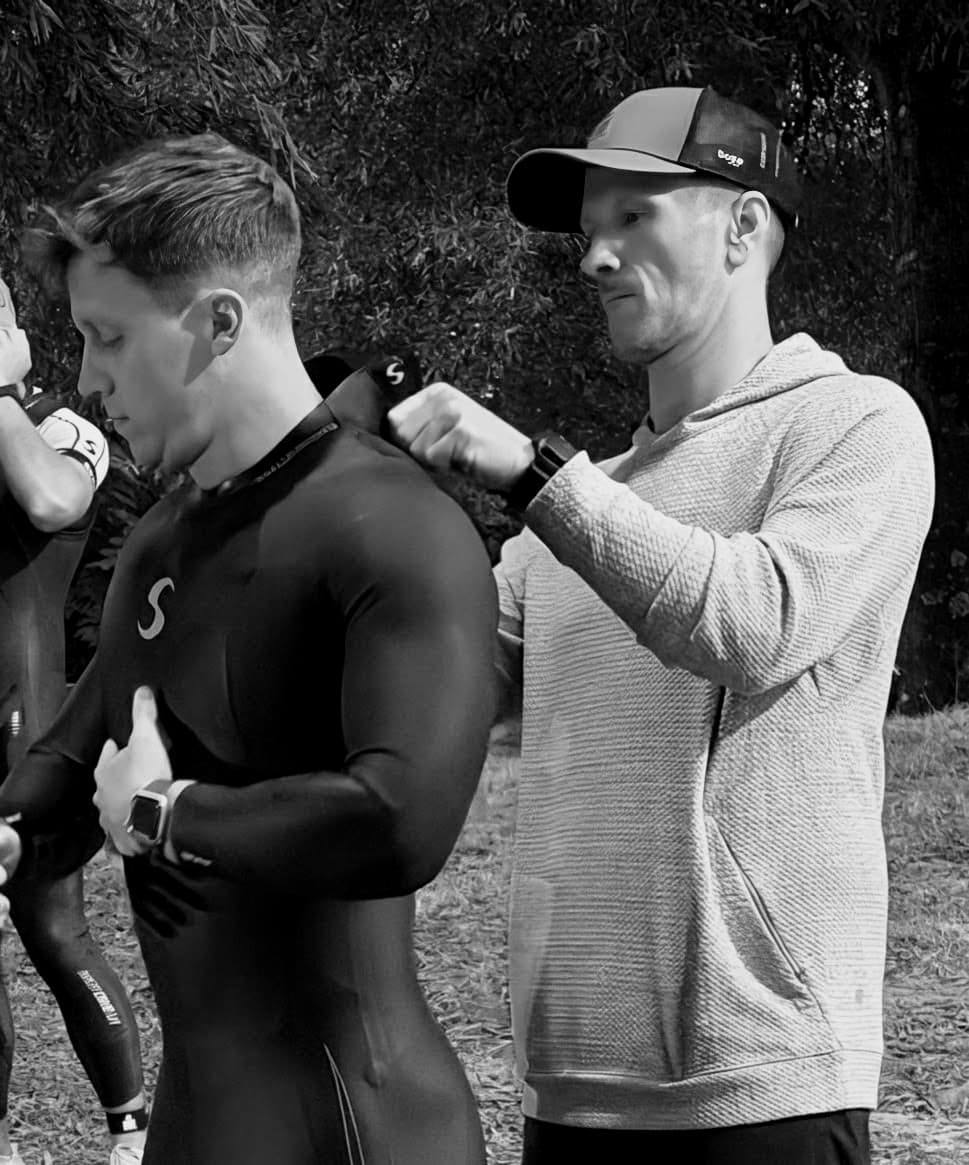
I was there to watch one of my athletes attempt his first IRONMAN, and sometime in those last few minutes before the swim, while I was helping him get into his wetsuit and making sure everything was where it needed to be, the whole thing suddenly looked different to me. I realized unequivocally that this was very serious business.
His family and friends were there along with his fiancé and his mother. People who had known him and loved him for a lifetime were gathering near the river before sunrise to watch him attempt something that was, by any reasonable measure, enormous. And then there was me, his coach. A man his mother had just met.
That realization landed harder than I expected. Her son trusted me. By referral, these people were being asked, in some small way, to trust me too. They were trusting that when I told him he was ready, I meant it. That I had not confused ambition with preparation. That all of those long rides, runs, open water swims, tired mornings and boring little decisions had added up to something substantial enough to carry him through the day.
It is easy to make coaching sound clinical. We talk about power, pace, heart rate, training load, recovery, nutrition. We look at graphs and charts and fitness trends and convince ourselves that if we understand enough numbers we can somehow make the uncertainty disappear. Standing next to his mother, none of those numbers felt especially important.
Her son was about to dive into a river with a thousand other people before the sun was fully up. His family members thanked me for helping them find a good place on the pier overlooking the swim exit. “Momma will have a nice view of her boy.” I don’t know why that sentence stayed with me the way it did, but it did.
Momma will have a nice view of her boy.
There was so much packed into that one line. Pride, mostly. But worry too. The kind of worry parents carry even when their children are grown and capable and standing in front of them wearing a wetsuit insisting that swimming several miles in a river before breakfast is a perfectly reasonable thing to do.
A few minutes later, his mother hugged him with tears in her eyes. Then he walked out toward the end of the pier. Then he was gone. And for the first time in months, I had absolutely no control over anything that happened next. No workout to adjust, text message to answer. No laptop or heart rate data or power file. No ability to say, “Back off a little,” or, “You’re good, keep going.” The preparation was finished and it was an uncomfortable feeling.
I remember something similar from wrestling. Losing a wrestling match always felt different from losing a soccer game. In a team sport, there are enough moving pieces that you can tell yourself stories afterward. Someone missed an assignment. Someone made a bad pass. Somebody else should have been there. Wrestling never offered much room for that. When you lost, you lost.
That’s a lonely feeling. The world felt very large when you were standing on that mat and very small when the whistle blew. Everything had narrowed down to what you had prepared yourself to do, and then you had to live with the result.
Standing beside the Tennessee River, I felt a distant version of that old sensation. The difference was that this time I wasn’t the one stepping onto the mat. Someone else was. Someone I had helped prepare.
I suppose I have spent much of my adult life in some version of that position. I taught piano when I was younger. I have managed software teams for years. Now I coach endurance athletes. Those things sound unrelated when you list them out, but they have always felt connected to me. In each case, someone is giving you a degree of influence over what they might become. That is not a small thing.
A student sits at a piano because they believe you know how to make them better. An employee takes your advice because they believe you can help them navigate something they have not encountered before. An athlete follows a training plan because they believe that when race morning comes, the work you prescribed will have prepared them for whatever waits on the other side. There is something deeply humbling about that kind of trust.
Eventually, my athlete came out of the water and he was so happy. Not politely happy or relieved in the understated way people sometimes try to look composed for photographs. He was absolutely lit up. He had just completed the first part of the day well ahead of what we expected, and you could see the confidence in him immediately.
But I found myself watching his family almost as much as I watched him. Something changed in them. The tension that had been sitting with them along the river began to loosen. The fear didn’t disappear completely, but it started to give way to something else. Belief. And that change continued throughout the day.
Later, during the run, I was sitting on a hill along the course when his family found me. They stayed for a while and we talked the way people talk at a picnic. They asked questions about triathlon and training. At one point someone asked me, almost casually, “Is this something a 60-year-old could pick up?” I laughed and told them, why not?
I met his sisters and his fiancée. We took pictures together. From the shade, we watched athletes run over and back across the sun-soaked bridge. We talked about what he was doing, how he looked and what came next. By then, I no longer felt quite like the stranger who had been standing next to his mother that morning. For a few hours, they had let me into something that belonged to their family. That was special.
Somewhere around mile 15, I was able to connect with him briefly. He was tired but looking strong which wasn’t particularly surprising. Anyone who has been around this sport long enough knows that eventually the race starts removing all the unnecessary parts of a person. Posture, faces, conversation all become contorted.
He looked at me and said, “My body’s not sweating anymore.” That got my attention. I told him to keep taking in electrolytes and that he was strong. Then I told him, “You’re going to be an IRONMAN.” There was nothing sophisticated about it. No coaching theory or metric. At that moment, I just wanted him to hear certainty from somebody he trusted. And he kept going.
Hours later, I watched him come through the finisher chute with tears gathering in his eyes. I’ve crossed finish lines myself. I know what it feels like when months of work suddenly collapse into a few seconds. Relief, pride, exhaustion and disbelief seem to arrive all at once. I’ve seen many of my athletes at the finish line before, but somehow, this one was different.
Watching him finish, I felt a kind of pride in my work that I don’t think I had ever felt before and the accomplishment didn’t even belong to me. He swam the river. rode the bike then ran the marathon. He dealt with the pain and the doubt and the fatigue. He made the decisions when nobody could make them for him. It was his finish line and I knew that. And I think, somewhere in the middle of all that emotion, I also understood that knowing this is part of the job.
Coaches can matter tremendously without making themselves the center of the story.
As I stood there, one of his family members approached me and shook my hand. “Congratulations,” he said. “You prepared him well. You have a part in this accomplishment also.” That meant more to me than I knew how to say at the time. Probably because I had spent so much of the day thinking about whether I deserved the trust they had placed in me and wondering if I’d truly done enough. But he somehow put the whole thing into exactly the right proportion. “You have a part in this accomplishment also.” A part…That was enough.
When my athlete finally made his way out of the finish area, the coach in me still had a couple of things left to do. I had him walk for a bit. I got him a chair. I told him to eat something and continue hydrating. I educated him on warning signs to watch out for over the next couple of days. I looked him over quickly and made sure nothing seemed immediately wrong. Then I looked around. His family was there. His fiancée was there. Everyone who had waited all day for this moment was there, just like they were in the morning. There wasn’t anything else I needed to do.
“Okay, my friend,” I told him. “This is where I leave you. Congratulations on a terrific day.” His mother and father shook my hand. We exchanged the sort of goodbyes people exchange after sharing a special day. “Until we meet again.” I said goodbye to everyone and then I walked away and I left him where the day had begun, by the river.
There was something fitting about that. A coach spends months preparing an athlete to leave him. That may be the strange truth at the center of all of this.
You teach, plan, advise, push and pull, worry and believe. You try to make yourself useful for as long as you are useful. Then, eventually, the athlete has to step onto the pier without you. If you have done the job well, there comes a moment when there is nothing left to say. The accomplishment belongs to him. The embrace, to his mother, and the tears to the people who love him. The coach gets something else. The knowledge that, for a little while, someone trusted you with a small part of their life, and that is enough.
My brother, Steve, had been with me for nearly the entire day and watched all of it unfold without ever really needing an explanation.
We started walking down Chestnut Street in Downtown Chattanooga as the sun started to set. And for the first time since sunrise, I had nothing left to monitor. No tracker pinging and no athlete somewhere out on the course who might need me.
I looked at Steve and said, “I think Edley’s has good barbeque.”